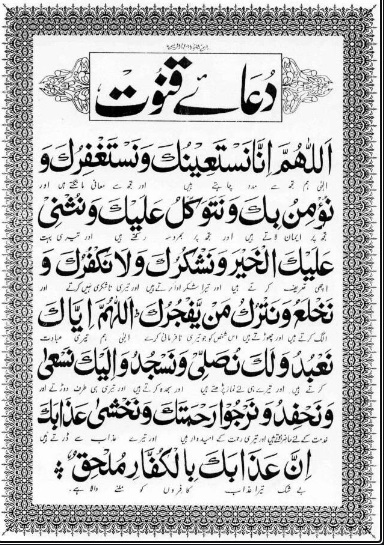
Islam teaches discipline, balance, and direct connection with Allah. One of the greatest gifts given to the Ummah during Shab-e-Meraj was the obligation of five daily prayers: Fajr, Dhuhr, Asr, Maghrib, and Isha. Along with these prayers, certain supplications hold special importance. Dua e Qunoot is one of them.
Dua e Qunoot is recited during Witr prayer, which is performed after the Isha prayer. It is not a random supplication. It is a structured dua taught by the Prophet Muhammad ﷺ, expressing humility, dependence on Allah, gratitude, and fear of His justice.
Why Dua e Qunoot Matters in Witr Prayer
Witr is not just another prayer added at the end of the day. It completes the night prayer and carries spiritual weight. Dua e Qunoot gives words to what a believer feels at that moment:
- Need for Allah’s help
- Seeking forgiveness
- Declaring complete trust in Him
- Rejecting disobedience and ingratitude
For this reason, every Muslim is encouraged to learn Dua e Qunoot in Arabic and also understand its meaning, especially in Urdu for better clarity.
How Dua e Qunoot Is Recited
Dua e Qunoot is recited in the third rak‘ah of Witr prayer, after standing up from ruku and before going into sujood.
Many people memorize the Arabic words without understanding them. That limits the impact of the dua. When the meaning is clear, the supplication becomes personal and heartfelt instead of mechanical.
To make learning easier, people often prefer:
- Reading Dua e Qunoot with Urdu translation
- Listening to MP3 audio recitation
- Using image or PDF formats on mobile devices
Dua e Qunoot – English Translation
O Allah,
We seek Your help and ask for Your forgiveness.
We believe in You and place our trust in You.
We praise You and thank You, and we are not ungrateful to You.
We turn away from and reject those who disobey You.
O Allah,
You alone do we worship.
To You alone we pray and prostrate.
O Allah,
We hope for Your mercy and fear Your punishment.
Surely, Your punishment will reach the disbelievers.
Dua e Qunoot – Urdu Translation
اے اللہ!
ہم تجھ سے مدد مانگتے ہیں اور تجھ سے بخشش چاہتے ہیں،
تجھ پر ایمان لاتے ہیں اور تجھ پر بھروسہ کرتے ہیں،
ہم تیری تعریف کرتے ہیں اور تیری ناشکری نہیں کرتے،
اور جو تیری نافرمانی کرے اس سے مکمل طور پر علیحدگی اختیار کرتے ہیں۔
اے اللہ!
ہم تیری ہی عبادت کرتے ہیں،
تیرے لیے ہی نماز پڑھتے ہیں اور تجھے ہی سجدہ کرتے ہیں۔
اے اللہ!
ہم تیری رحمت کے امیدوار ہیں
اور تیرے عذاب سے ڈرتے ہیں،
بے شک تیرا عذاب کافروں کو پہنچنے والا ہے۔
Reading Dua e Qunoot Through Images and PDFs
Many readers prefer visual formats for memorization. That is why Dua e Qunoot is often shared as:
- Image with Arabic text and Urdu translation
- PDF file for offline reading
- Mobile-friendly layout for daily use
These formats help students, elders, and new learners recite Dua e Qunoot correctly without confusion.
Listening to Dua e Qunoot Audio
Audio recitation plays an important role, especially for pronunciation. Repeated listening helps:
- Correct Arabic accent
- Smooth memorization
- Confidence during prayer
MP3 audio versions of Dua e Qunoot are commonly used before or after Isha prayer to reinforce learning.
Who Should Use This Resource
This guide is useful for:
- Students learning prayer basics
- Adults correcting their Witr prayer
- Parents teaching children
- Anyone wanting to understand what they recite
Understanding Dua e Qunoot transforms Witr prayer from routine worship into a conscious conversation with Allah.
Final Thought
Dua e Qunoot is not long, but it is deep. When recited with understanding, it reflects faith, gratitude, hope, and fear — all in one supplication. Learning it with Urdu and English translation removes confusion and strengthens sincerity in prayer.
If you regularly pray Witr, knowing the meaning of Dua e Qunoot is not optional. It is part of praying with awareness.

Zeshan Akram is a senior social and educational content analyst with a Master’s degree in Sociology. He specializes in Islamic topics, public schemes, and prices, explaining policies with cultural context and verified public information.