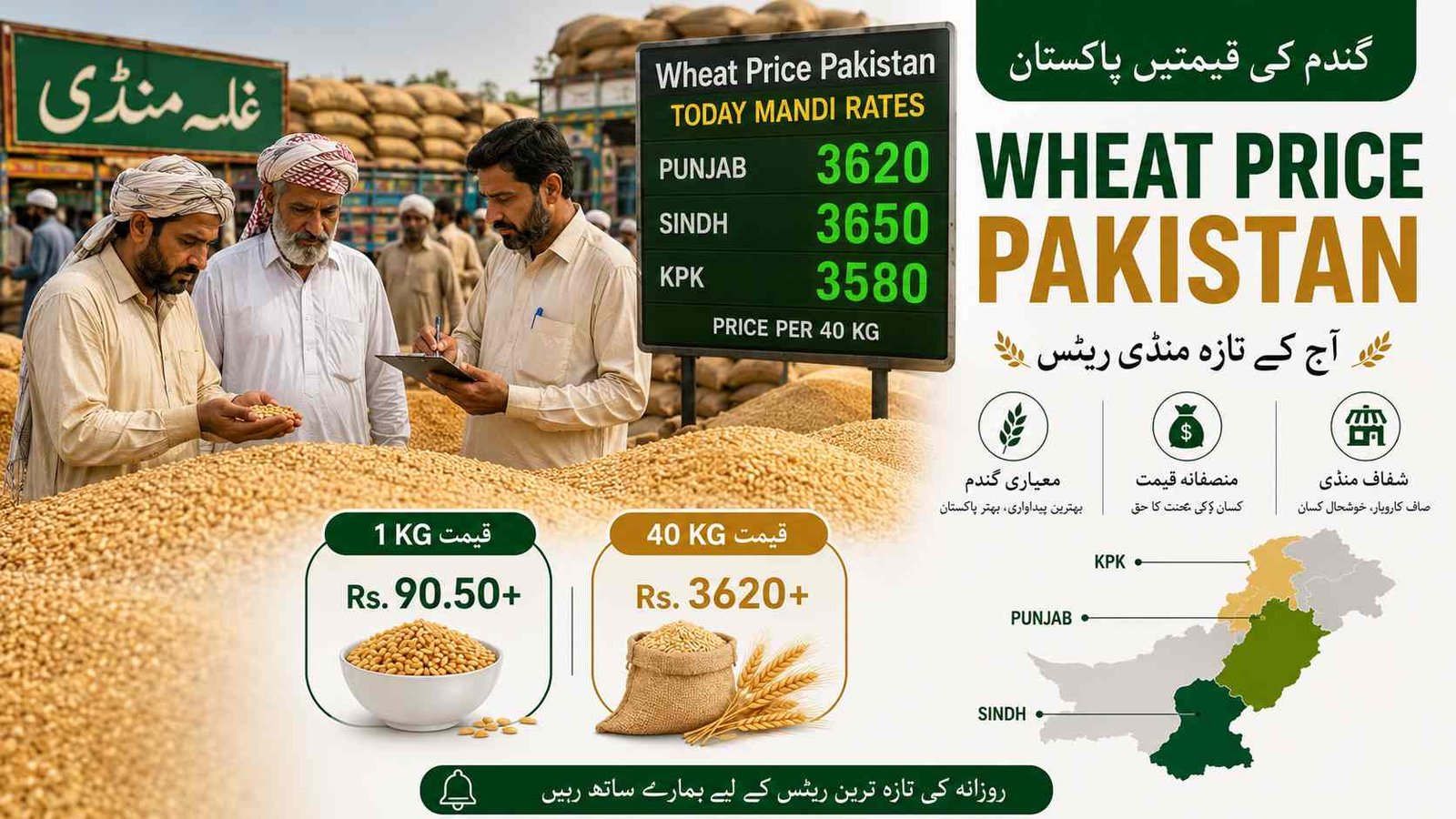
For ordinary buyers, wheat and atta prices remain higher than the official support rate because flour mills, retailers, transporters, and storage agents add extra costs before wheat reaches the market.
Pakistan’s wheat market also changes quickly during harvesting months. A rate seen in Lahore may not match prices in Karachi, Peshawar, Multan, or smaller mandi areas on the same day. That is why farmers and buyers should always compare government rates with local market conditions before making selling or purchasing decisions.
What Is the Official Government Wheat Price Per 40 KG in Pakistan?
The federal government has announced an official procurement price of Rs. 3,500 per 40 KG wheat for the current procurement season. The National Wheat Oversight Committee confirmed this rate during meetings involving the Ministry of National Food Security and provincial departments.
This support price mainly applies when wheat is sold to government procurement centers such as PASSCO and provincial food departments. It does not guarantee that every farmer will automatically receive the same amount in the private market.
Here is how the official calculation works:
| Wheat Quantity | Official Government Rate |
|---|---|
| 1 KG | Rs. 87.5 |
| 10 KG | Rs. 875 |
| 20 KG | Rs. 1,750 |
| 40 KG | Rs. 3,500 |
Punjab and Sindh have publicly aligned their procurement operations with the same support price. KPK also follows the federal pricing framework, although actual open market trading may differ district by district.
What Is the Wheat Price Per KG in Punjab, Sindh, and KPK?
The retail and mandi wheat rates differ from official procurement prices because open markets respond faster to supply pressure, weather changes, transport shortages, and private mill demand.
Current market observations from agricultural rate platforms and mandi reporting systems show the following ranges:
| Province | Approx Open Market Rate Per KG | Approx Open Market Rate Per 40 KG |
|---|---|---|
| Punjab | Rs. 85–95 | Rs. 3,400–3,550 |
| Sindh | Rs. 88–100 | Rs. 3,500–4,000 |
| KPK | Rs. 90–105 | Rs. 3,600–4,200 |
These figures can shift daily depending on wheat moisture levels, storage quality, and local procurement activity.
Punjab generally shows more stable rates because it produces the largest wheat crop in Pakistan and has stronger procurement infrastructure. Sindh rates can rise faster near Karachi because of transport and flour demand. KPK often records slightly higher prices because wheat movement from Punjab adds freight expenses.
Why Do Wheat Prices Change Across Pakistan?
Many people assume the government support price controls the entire market. In reality, wheat pricing in Pakistan depends on several moving factors at the same time.
The biggest factor is procurement pressure. When government agencies actively purchase wheat from farmers, private buyers must compete harder. That usually pushes open market rates upward.
Weather also matters. Heavy rain during harvesting season can reduce grain quality. Lower quality wheat often sells below support price levels because flour mills reject damaged stock.
Transport costs create another difference. Wheat moving from South Punjab to Karachi or northern KPK becomes more expensive because diesel prices, loading costs, and storage charges increase the final market rate.
Farmers also watch international wheat trends. Imported wheat policies, exchange rates, and global grain shortages can affect local prices indirectly.
The following situations commonly move wheat prices in Pakistan:
- Delayed government procurement
- Shortage of storage facilities
- Fuel price increases
- Heavy rainfall during harvest
- Flour mill demand spikes
- Import policy changes
- Smuggling pressure near border regions
What Is the Difference Between Retail Wheat and Mandi Wheat Rates?
This is where many ordinary buyers become confused.
The mandi rate reflects raw wheat trading between farmers, dealers, and procurement agencies. Retail flour prices include grinding, packaging, transport, dealer commissions, electricity, and shop margins.
That is why 1 KG wheat may officially calculate near Rs. 87.5, but consumers often pay significantly more for atta in retail markets.
In major cities, flour prices can remain high even when wheat procurement rates stay stable. Urban transport systems, electricity bills, and supply chain inefficiencies all increase final costs.
Some online posts also mix wheat grain rates with flour bag rates, which creates additional confusion for readers. Wheat grain and packaged flour are not the same product category.
What Is the Cotton Rate in Pakistan Today Per 40 KG Punjab?
Many farmers compare wheat and cotton prices before deciding which crop to grow next season.
Cotton rates in Punjab do not follow the same fixed support structure as wheat. Cotton pricing changes more aggressively based on textile exports, international demand, and local ginning activity.
Recent mandi discussions in Punjab show cotton rates moving significantly higher per maund compared to wheat, although cotton farming also carries greater weather and pest risks.
Farmers in South Punjab especially compare these two crops because land, water, and fertilizer expenses strongly affect profitability decisions.
When wheat support prices remain lower than production costs, some growers shift toward cotton or sugarcane in the following season.
What Affects Wheat Prices in Punjab, Pakistan?
Punjab remains Pakistan’s largest wheat-producing province, so local changes there often influence national supply trends.
Three major factors currently affect Punjab wheat pricing:
First, procurement timing. If procurement centers open late, farmers sometimes sell early to private traders at lower prices because they need immediate cash.
Second, production costs. Farmers continue reporting higher fertilizer, diesel, pesticide, and labor expenses. Some agricultural groups argue that the Rs. 3,500 support rate still does not fully match production realities.
Third, storage pressure. Small farmers without proper storage facilities often cannot wait for better prices. They sell quickly after harvest, which temporarily lowers open market rates.
Districts such as Faisalabad, Multan, Bahawalpur, and Sahiwal usually become key indicators for Punjab wheat pricing trends because of their strong agricultural output.
How Much Is 1 KG of Wheat in Pakistan?
The answer depends on whether someone means:
- Official government procurement rate
- Wholesale mandi rate
- Retail grain shop rate
- Flour market rate
Based on the official government support price, 1 KG wheat equals about Rs. 87.5.
However, actual retail wheat prices commonly range between Rs. 90 and Rs. 110 per KG depending on province, transportation costs, and market demand.
In remote districts or areas facing transport shortages, prices may move even higher for short periods.
What Should Farmers and Buyers Watch Before Selling Wheat?
Farmers should avoid relying only on social media screenshots or unofficial WhatsApp rate claims. Wheat prices can differ between official procurement centers and private traders on the same day.
Moisture level testing also matters. Wet wheat or poorly stored wheat often receives lower offers even when official support prices look attractive on paper.
Buyers should compare local mandi rates instead of assuming federal announcements automatically control retail markets.
The Ministry of National Food Security, PASSCO, provincial food departments, and local mandi committees remain the most reliable sources for verified procurement information.
Pakistan’s wheat market changes quickly during harvesting months. Watching only one headline price without understanding local conditions can lead to poor selling or purchasing decisions.

Zeshan Akram is a senior social and educational content analyst with a Master’s degree in Sociology. He specializes in Islamic topics, public schemes, and prices, explaining policies with cultural context and verified public information.