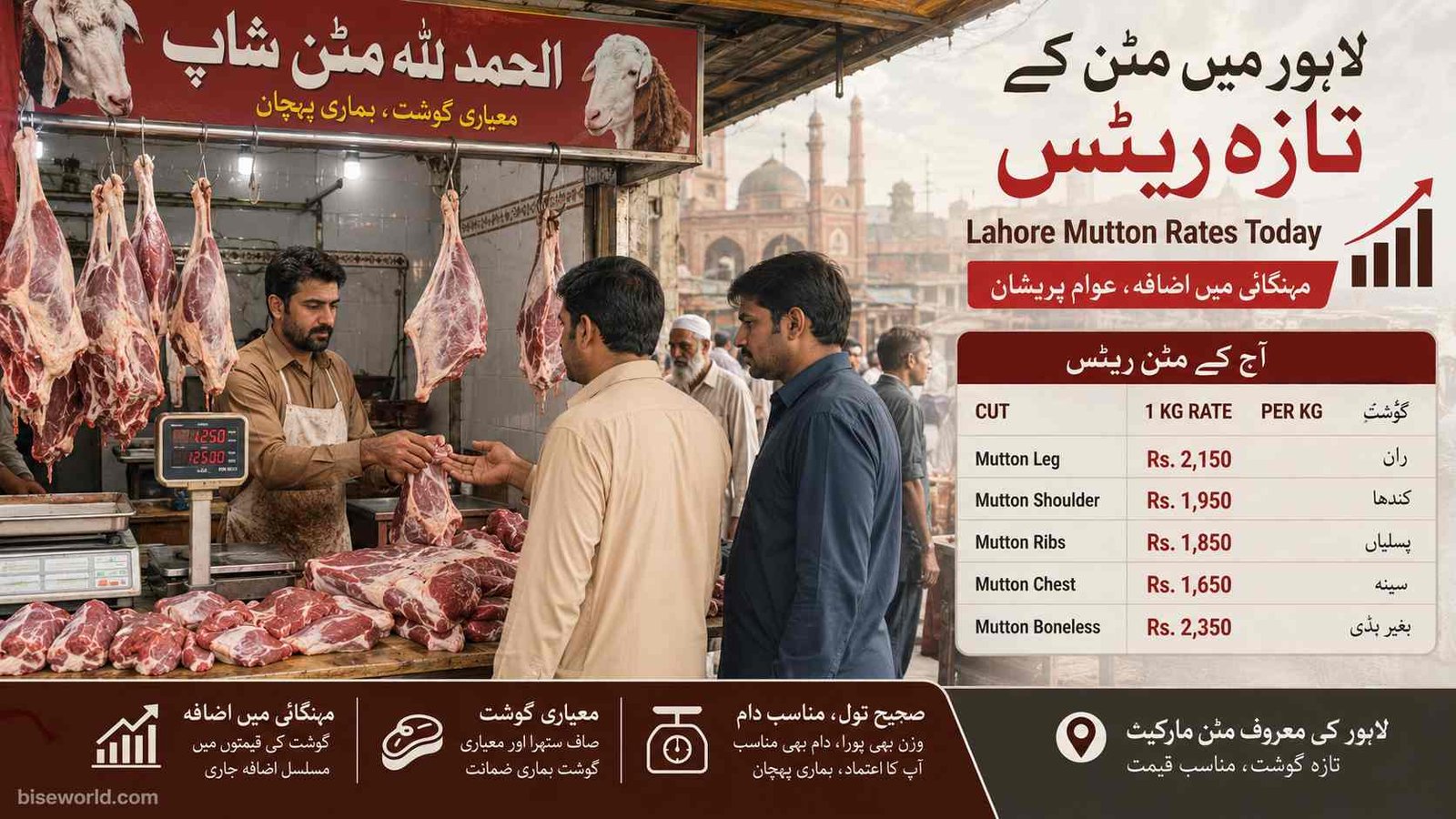
People searching for mutton prices usually want one thing: a realistic number before they go to the market. That matters more now because meat prices in Pakistan no longer stay stable for long periods. Feed costs, transport expenses, inflation, electricity bills, and Eid demand all affect what butchers charge in Lahore.
Zeshan Akram’s editorial framework for prices and public-impact topics was followed for this article.
What Is the Current 1 KG Mutton Price in Lahore?
Punjab government commodity lists currently show Lahore mutton around PKR 1,600 per kg as an official reference rate.
But buyers in Lahore already know there is often a difference between:
- Official notified rates
- Actual butcher shop prices
- Premium meat shop pricing
- Boneless or special-cut rates
In many urban areas such as DHA, Gulberg, Johar Town, Bahria Town, and Model Town, high-quality goat meat frequently crosses PKR 2,000 per kg. Bone-heavy cuts may cost less, while boneless red meat costs more.
Here is what buyers commonly see in Lahore markets:
| Mutton Type | Expected Lahore Market Rate |
|---|---|
| Official reference rate | Around PKR 1,600/kg |
| Mixed cut mutton | PKR 1,700–1,900/kg |
| Premium goat meat | PKR 2,000–2,200/kg |
| Boneless mutton | PKR 2,200+/kg |
These figures change quickly during holidays and livestock shortages.
Why Are Mutton Prices Rising in Lahore?
Most people blame butchers only. The reality is broader.
Pakistan’s livestock supply chain has become expensive at almost every stage. Farmers now spend more on animal feed, medicine, transport diesel, electricity, and labor. When those costs rise, meat prices rise too.
Lahore also depends heavily on livestock movement from rural Punjab and nearby districts. Fuel price increases directly affect transportation costs. Even small changes in diesel rates can increase meat prices in city markets within days.
Another factor is urban demand. Lahore remains one of Pakistan’s largest food-consuming cities. Restaurants, wedding halls, hotels, BBQ businesses, and home events create constant pressure on meat supply.
Government departments publish official commodity rates daily, but enforcement varies from area to area. That is why one market may follow the notified rate while another exceeds it significantly.
| City | Official/Reference Mutton Price (1 KG) | Common Market Range | Notes |
|---|---|---|---|
| Lahore | PKR 1,600 | PKR 1,700–2,200 | Premium areas charge higher rates |
| Karachi | PKR 1,700 | PKR 1,900–2,400 | Higher transport and urban demand |
| Islamabad | PKR 1,650 | PKR 1,900–2,300 | Elite sectors often exceed average rates |
| Rawalpindi | PKR 1,600 | PKR 1,800–2,200 | Linked closely with Islamabad pricing |
| Faisalabad | PKR 1,550 | PKR 1,700–2,000 | Large livestock supply helps stability |
| Multan | PKR 1,500 | PKR 1,650–1,950 | Slightly lower than major metro cities |
| Peshawar | PKR 1,550 | PKR 1,700–2,100 | Demand increases strongly in winter |
| Quetta | PKR 1,500 | PKR 1,650–2,000 | Livestock availability affects daily rates |
Are Mutton Prices Seasonal in Pakistan?
Yes. Mutton prices in Pakistan are strongly seasonal.
The biggest spike usually comes before Eid ul Adha. Animal demand increases nationwide, and ordinary meat markets also become expensive during that period. Some butchers reduce supply because many people purchase sacrificial animals directly instead of buying meat from shops.
Winter also affects prices. In colder months, meat consumption increases across Punjab. Families cook more traditional dishes such as:
- Paya
- Nihari
- Karahi
- Mutton pulao
- Barbecue items
Wedding season pushes prices higher too. Lahore’s event industry consumes a large amount of goat meat every week during peak marriage months.
This is why people comparing one month’s rate to another often become confused. Meat prices in Pakistan do not behave like fixed supermarket pricing systems found in some other countries.
Which Type of Mutton Costs More in Lahore?
Goat meat usually costs more than sheep meat in Lahore because many consumers believe goat meat has better taste, lower fat, and higher cooking quality.
Boneless meat also costs more because the butcher removes waste weight before sale.
A buyer paying for 1 KG of mixed-cut mutton may receive:
- Bone pieces
- Fat
- Rib sections
- Smaller meat portions
That changes the actual usable meat quantity at home.
Some premium meat shops advertise “clean meat” or “special handi cut” pricing. Those cuts target restaurants and higher-income buyers.
People should also understand that imported frozen meat and local fresh meat are completely different markets. Lahore consumers generally prefer fresh local slaughter meat despite higher prices.
How Much Did 1 KG Mutton Cost in Pakistan in 2015?
In 2015, mutton prices in many Pakistani cities commonly ranged between PKR 700 and PKR 1,000 per kg, depending on region and meat quality.
That comparison shocks many buyers today because the current rate in Lahore has nearly doubled or even tripled in some premium markets.
But simple comparison without context can mislead readers.
Pakistan’s economy has changed significantly since 2015:
- Rupee value weakened
- Fuel costs increased
- Livestock feed became expensive
- Electricity and transport charges rose
- Urban food demand expanded rapidly
So the price increase reflects wider inflation pressure, not only meat seller profits.
How Many Pieces Usually Come in 1 KG of Mutton?
There is no fixed national answer because butchers cut meat differently.
In Lahore markets, 1 KG of mutton may contain:
- 8 to 15 medium pieces
- More bones in cheaper cuts
- Fewer but larger pieces in premium cuts
Karahi cuts, handi cuts, and BBQ cuts all produce different piece counts.
This is one of the most common buyer misunderstandings. Some customers focus only on total weight and ignore bone percentage. Others prefer larger pieces even if quantity looks smaller.
Experienced buyers often ask the butcher to cut meat according to the dish they plan to cook.
Where Can People Check Official Meat Rates in Punjab?
Punjab government departments publish daily commodity rates online through the Food Safety & Consumer Protection Department and related district systems.
The Lahore district administration also publishes essential commodity rate lists periodically.
These rates help consumers understand the government reference price, but they should not assume every shop follows the same rate exactly.
Real market prices can differ because of:
- Area location
- Meat quality
- Shop reputation
- Freshness
- Bone ratio
- Supply shortages
- Seasonal demand
That difference becomes more visible during Ramadan and Eid seasons.
What Should Buyers Check Before Purchasing Mutton?
Most people only ask the price. That creates problems later.
A lower rate sometimes means lower usable meat quantity.
Buyers should carefully check:
- Fresh smell and natural color
- Bone-to-meat ratio
- Weight measurement accuracy
- Excess fat inclusion
- Whether meat is fresh or old stock
In crowded Lahore markets, some buyers also complain about wet meat weighing more because of added moisture.
Trusted butchers often charge slightly more but maintain consistent quality.
What Can Buyers Expect in Coming Months?
There is no confirmed official forecast for future mutton prices in Lahore.
However, market pressure remains high because inflation, livestock costs, and urban food demand continue affecting Pakistan’s meat sector. If fuel prices rise again or Eid demand increases sharply, retail mutton prices may move higher in several Lahore markets.
Government commodity systems still provide public reference rates, but buyers should expect daily fluctuations rather than long-term stability.
What should you do next? Before buying meat in Lahore, compare at least two nearby markets instead of relying on a single shop’s price board.

Zeshan Akram is a senior social and educational content analyst with a Master’s degree in Sociology. He specializes in Islamic topics, public schemes, and prices, explaining policies with cultural context and verified public information.